
Quantum Materials
Quantum materials exhibit a wide range of emergent phenomena arising from the quantum nature of electrons. These include topological materials and strongly correlated systems, which are central to modern condensed matter research.
Looking at the Edge: The Emergence of Topological Insulators
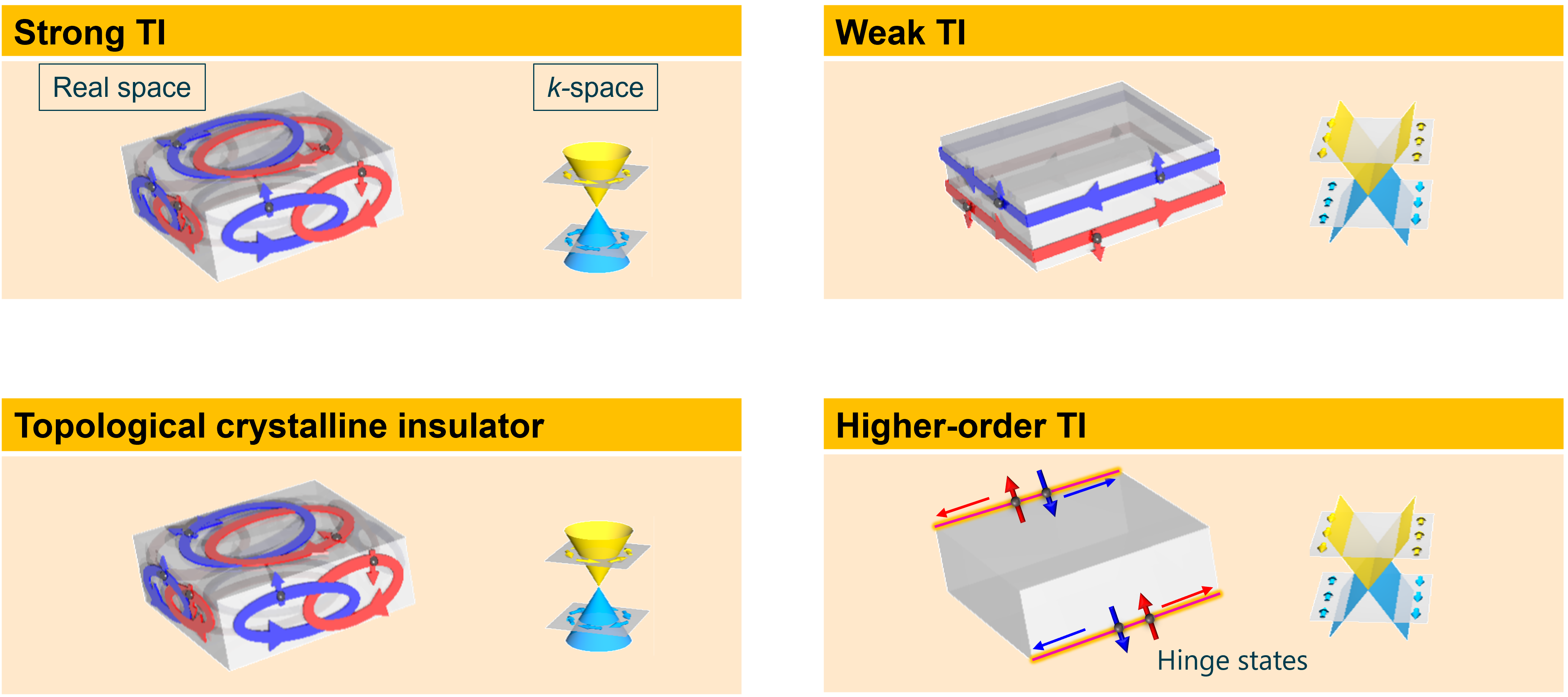
Topological materials display striking quantum effects such as spin currents, quantized conductance, and unconventional magneto-electric responses. A landmark example is the quantum spin Hall insulator, which was first predicted theoretically and later realized experimentally. It features spin-polarized edge currents surrounding an insulating bulk. This concept has since been extended into three dimensions, leading to the discovery of strong, weak, crystalline, and higher-order topological insulators. In strong topological insulators, robust spin-polarized surface states appear on all surfaces. Weak topological insulators exhibit these states only on certain surfaces. Higher-order topological insulators go further, hosting one-dimensional hinge states protected by the higher-order topology of the bulk electronic structure. These edge and surface states provide a unique platform to explore exotic topological phenomena.
Where Correlations Meet Topology
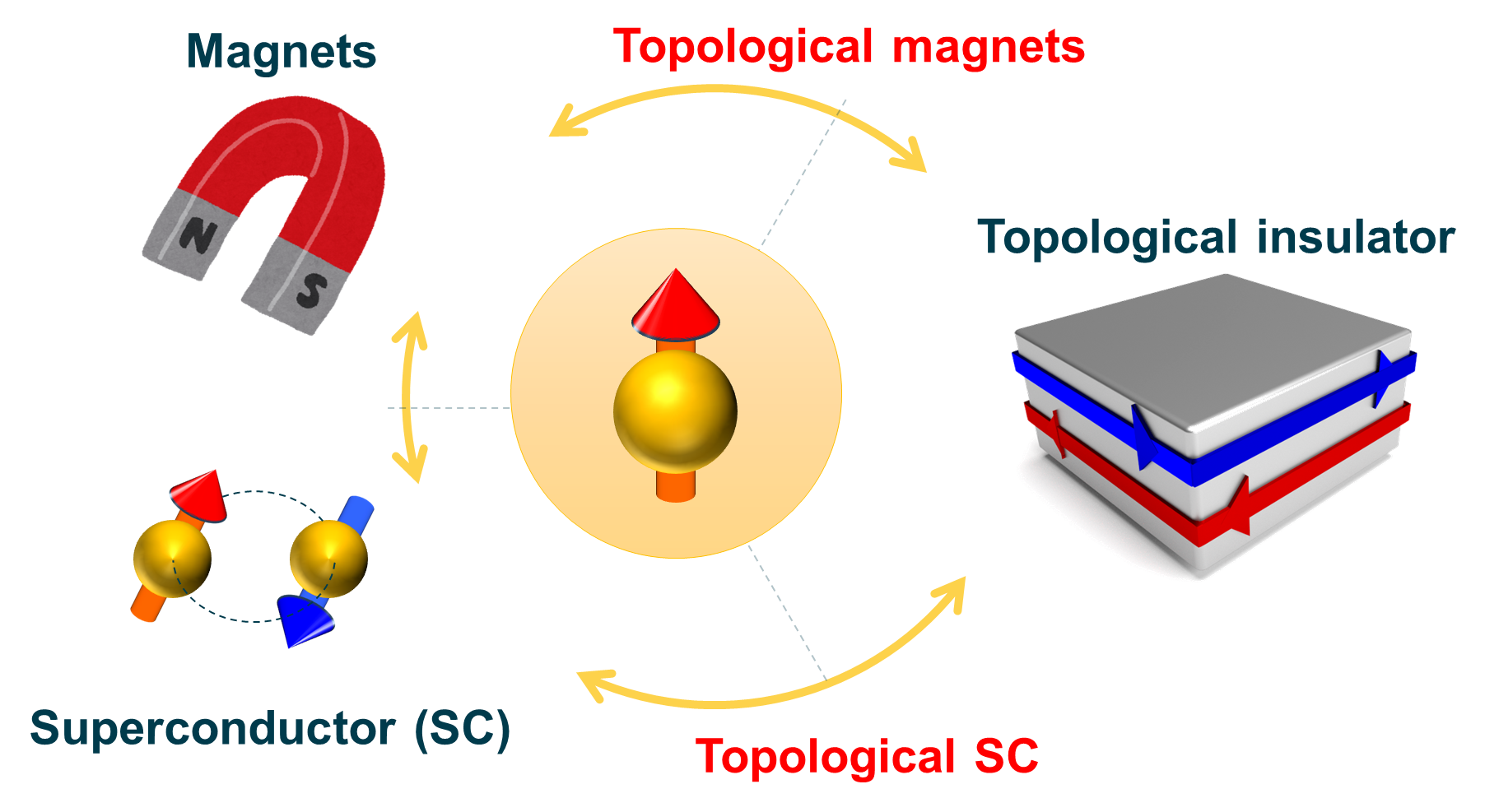
Meanwhile, strongly correlated materials give rise to rich behaviors such as magnetism and superconductivity. When these interactions meet nontrivial topology, the result is correlated topological materials — systems that are not only scientifically intriguing but also highly promising for applications. Examples include topological magnets and topological superconductors, which hold potential for energy-efficient spintronic devices and quantum computing. These materials are responsive to external stimuli, allowing for dynamic control of their quantum states. Moreover, they bridge concepts between condensed matter and high-energy physics. Topological superconductors are predicted to host Majorana bound states and may exhibit emergent supersymmetry near phase transitions. Topological magnets display phenomena such as chiral anomalies and axion electrodynamics.
Quantum Phases in Our Hands
Our research aims to discover new materials platform and to develop methods to dynamically control topological phases — both correlated and non-correlated — in order to design next-generation functional materials and deepen our understanding of the fundamental quantum physics that governs them. To this end, we will apply the following probing and control methods to topological quantum materials.
Probing techniques
We are developing state-of-the-art laser techniques in our laboratory, including laser-ARPES and ultrafast optical spectroscopy. In addition, we utilize synchrotron facilities in and outside Taiwan which provide different capabilities.
ARPES
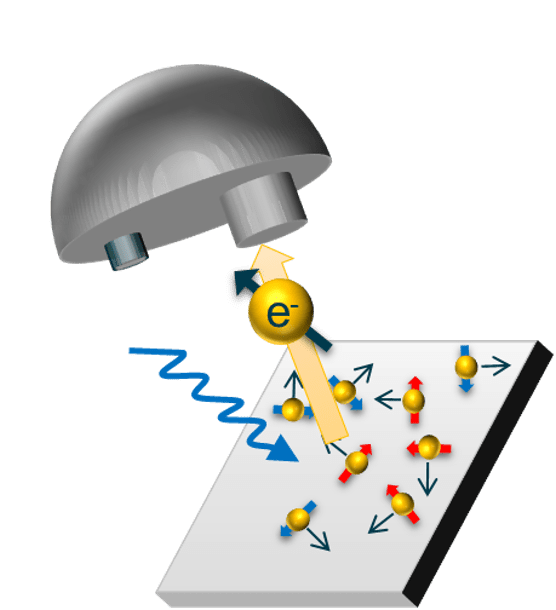
Angle-resolved photoemission spectroscopy (ARPES) is a powerful tool for revealing the electronic structure of a material. It exploits the photoelectron effect and resolves the angle and energy of the electrons, providing information about the band structure inside a solid. ARPES has played a major role in the discovery of topological materials and the determination of the gap anisotropy of superconductors.
Ultrafast laser spectroscopy
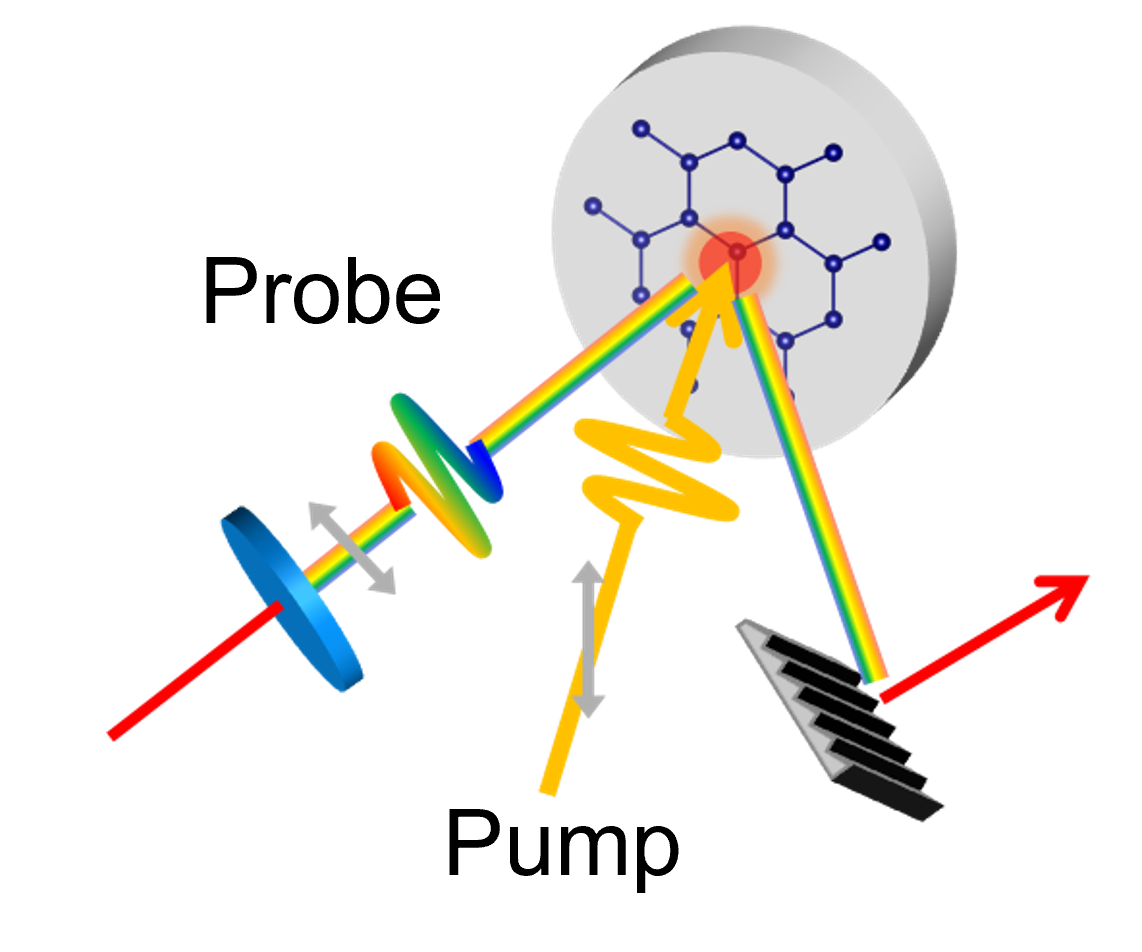
The electronic structure of a material characterizes optical properties such as optical density and reflectivity. Using ultrafast laser pulses with a temporal width of less than 100 femtoseconds, we can excite the system with a pump pulse and monitor the change with a probe pulse on an ultrafast timescale. The observed behavior of the optical properties contains information about the dynamical aspect of electronic, magnetic and lattice systems.
Synchrotron facilities
Synchrotron facilities provide us with various opportunities – a great advantage is the high tunability of photon energy, which is essential for utilizing resonant techniques and also three-dimensional analysis of ARPES results. We will actively travel to synchrotron facilities in Taiwan and abroad to perform various kinds of experiments.

How to control quantum materials?
The properties of a material can be modified by different types of perturbation. We aim to find efficient tuning parameters and combine our spectroscopy techniques to demonstrate and harness the functionality of quantum materials.
Optical driving
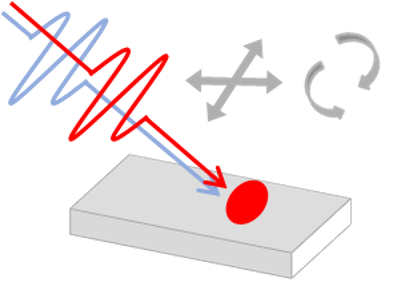
Ultrafast laser pulses can drastically modify the properties of a material transiently. We aim to investigate the effects of optical driving, including Floquet effects, to explore light-induced topological phase transitions.
Strain tuning
The lattice parameter is a useful tuning control for quantum phases. Recently, ARPES has been successfully combined with strain devices to study topological phase transitions and beyond. We will use this technique to search for manipulable phase transitions and explore critical phenomena in topological quantum materials.

Thin film growth
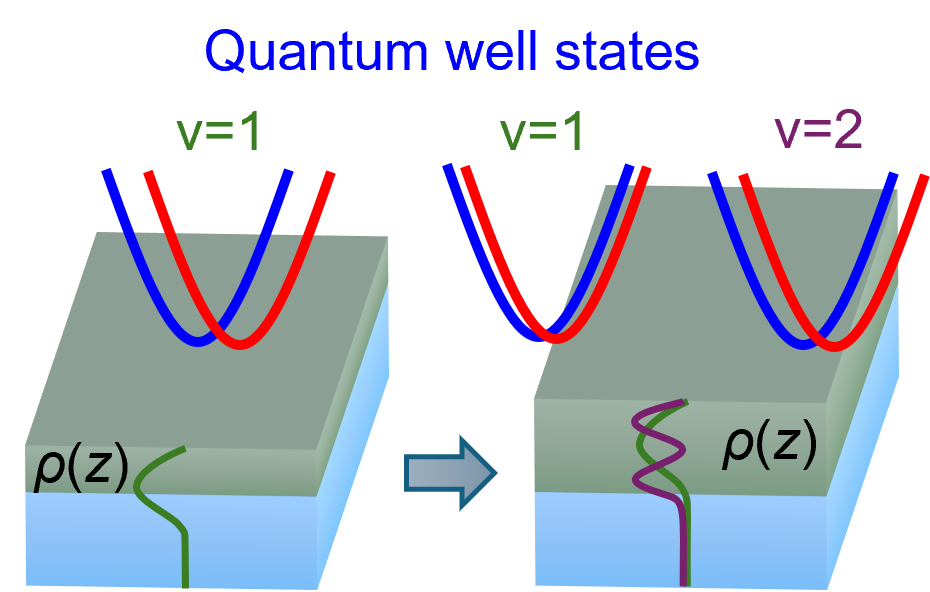
Pauli’s quote, “God created solids, the devil their surfaces,” captures the difficulty of understanding surface phenomena that are not bound by crystal symmetry in three dimensions. Nevertheless, when the system is appropriately chosen and prepared, surface science offers a new platform for exploring the control of quantum physics. Surface phenomena, including surface alloy formation, quantum confinement, and proximity superconductivity, exploit the latent potential of surface physics beyond 3D systems.
 SpecTopo Lab